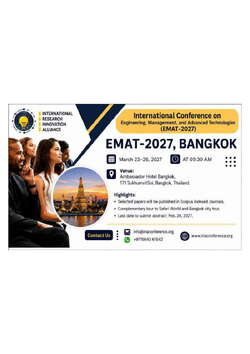
The 47th World Congress on Chemical, Biological & Environmental Engineering (WCBEE 2025) covers advancements in chemical, biological, and environmental engineering through cutting-edge technologies, sustainable solutions, and interdisciplinary approaches to address global challenges.
Key Topics
- Membrane filtration for water purification and desalination
- Digital twins and Industry 4.0 in chemical processes
- Design and synthesis of biocompatible materials
- Carbon capture, utilization, and storage technologies
- Hazard identification and risk assessment in industrial processes
- Omics data analysis in biological systems
- CRISPR-based tools for genetic engineering
- Multiphase flows and granular material dynamics
- Ethical considerations in genetic engineering and policy development
- Hybrid and advanced separation processes
- Microbial fuel cells and bioelectrochemical systems
- Process integration and pinch analysis
- Machine learning for biological and environmental data interpretation
- Industrial symbiosis and eco-industrial parks
- Advanced catalytic converters and emission control systems
- Modeling and simulation tools like Aspen Plus and CFD
- Design for sustainability and eco-efficiency
- Fermentation and downstream bioprocessing
- Biomaterials for implants and tissue scaffolds
- Contaminated land and soil remediation strategies
- Nanotechnology for drug delivery and environmental applications
- Sustainable energy systems for climate adaptation
- Bioremediation and bioenergy from waste biomass
- Phase equilibria in complex mixtures
- Greenhouse gas emission reduction approaches
- Process safety and environmental risk management
- Remote sensing and GIS for environmental assessment
- Biomanufacturing of pharmaceuticals, fuels, and materials
- Education and curriculum innovation in C.B.E. engineering
- Electrocatalysis and photocatalysis for chemical synthesis
- Advanced oxidation and removal of emerging water pollutants
- AI for optimization and predictive maintenance in processes
- Recycling, upcycling, and circular economy in waste management
- Tissue engineering and regenerative medicine technologies
- Valorization of waste streams in the circular bioeconomy
- Development of biosensors and synthetic gene circuits
Who should Attend
- Researchers in bioprocess and synthetic biology
- Environmental engineers and sustainability professionals
- Experts in nanotechnology and biomedical applications
- Professionals in industrial safety and risk assessment
- Policy makers and environmental regulators
- Students and educators in chemical and biological engineering
- Specialists in climate adaptation and mitigation
- Process engineers and control system designers
- Scientists in air and water pollution control
- Technologists in AI, machine learning, and data analytics
- Developers of novel materials and catalysis
- Waste management and resource recovery practitioners